Pakistan Influencer Marketing Spending in 2026: How Much Are Brands Really Paying?
Pakistan influencer marketing spending is becoming an increasingly important part of the country’s digital advertising market. As brands invest more in Instagram, TikTok, YouTube and creator-led campaigns, influencer partnerships are moving beyond simple sponsored posts and celebrity endorsements. But how much are Pakistani brands really spending, and which types of creators are receiving the biggest share of these budgets?
But one question remains difficult to answer: how much are Pakistani brands actually spending on influencer marketing?
There is no single publicly reported figure covering the entire market. However, creator-rate benchmarks, audience data, industry research and recent developments provide enough evidence to understand how Pakistan influencer marketing spending is changing — and where brands are putting their money.
Pakistan’s Influencer Marketing Market Is Getting Bigger
The size of Pakistan’s digital audience explains why brands are increasingly interested in creators.
According to the latest DataReportal Digital 2027 Pakistan report, Pakistan had 149 million internet users and 94.1 million social media user identities in October 2026. DataReportal also reports that social media user identities increased by 17.7% year over year.
That gives brands a huge potential audience for creator-led campaigns.
Platform-level advertising data is equally significant. YouTube’s reported advertising reach in Pakistan reached 60.6 million users in late 2026, while TikTok reported 94.1 million adults and Instagram reported an advertising reach equivalent to 16% of Pakistan’s adult population.
These figures should not be interpreted as unique monthly active users, because platform advertising audiences use different methodologies. Nevertheless, they demonstrate the scale of the market available to advertisers.
This growth is also part of a broader transformation in social media strategy. Brands are increasingly competing for attention through creators, short-form video and community-led content rather than relying entirely on traditional advertising.
How Much Does an Influencer Cost in Pakistan?
There is no universal rate card for Pakistani influencers. Pricing depends on followers, engagement, niche, audience location, content quality, platform and the amount of work required.
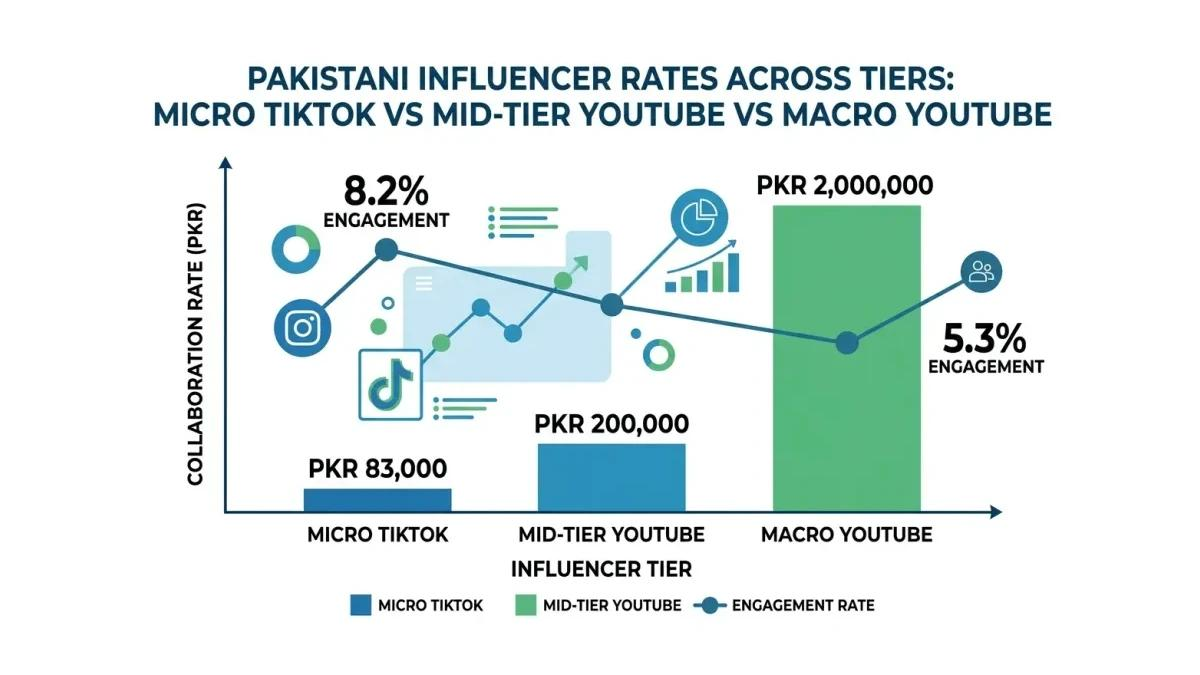
A useful 2026 benchmark comes from Wasta’s influencer-rate guide for Pakistan. Its indicative rates show that one Instagram Reel can cost approximately:
| Creator Tier | Followers | Indicative Reel Rate |
|---|---|---|
| Nano | 1K–10K | Rs2,000–8,000 |
| Micro | 10K–50K | Rs8,000–25,000 |
| Mid-tier | 50K–250K | Rs30,000–120,000 |
| Macro/Celebrity | 250K+ | Campaign-specific |
These are benchmarks rather than fixed industry prices. A creator with a highly engaged audience in a valuable niche can charge more than another creator with substantially more followers.
The final price can also increase when brands request advertising usage rights, exclusivity, multiple revisions, professional production or additional deliverables.
What Does a Real Brand Campaign Cost?
Looking at individual creator rates gives a better understanding of Pakistan influencer marketing spending and how brands distribute their campaign budgets.
For example, imagine a hypothetical campaign using:
- 20 nano creators at Rs5,000 each
- 15 micro creators at Rs15,000 each
- 5 mid-tier creators at Rs60,000 each
The creator fees alone would total approximately Rs775,000.
A larger national campaign involving celebrity creators, professional production, paid amplification and usage rights could easily reach several million rupees.
This demonstrates why influencer marketing budgets cannot be estimated simply by looking at one creator’s fee.
Brands may spend money across several layers:
Creator fees → Content production → Agency fees → Paid amplification → Usage rights → Measurement
The campaign budget can therefore become significantly larger than the amount paid directly to creators.
Micro-Influencers Could Be the Biggest Opportunity
One of the most interesting developments in Pakistan influencer marketing spending is the growing importance of smaller creators.
Earlier Pakistani industry research already showed that influencer marketing was becoming increasingly measurable. Walee’s Pakistan Influencer Industry Insights Report analyzed more than 1,000 Instagram posts over a 12-month period and examined campaign performance using engagement data.
The research found that fashion accounted for 23.6% of influencer activity, beauty for 22.2% and FMCG for 15.6%. Transport and telecommunications campaigns recorded particularly strong average engagement rates.
The important lesson for brands is that audience relevance can matter more than audience size.
A beauty creator with 30,000 highly engaged followers may be more useful to a skincare brand than a celebrity with several million followers whose audience is less relevant.
This creates an opportunity for companies with smaller budgets.
Instead of spending the entire campaign budget on one celebrity, a brand can distribute the budget across dozens of smaller creators and reach multiple communities.
Which Industries Are Spending on Influencers?
Influencer marketing is particularly attractive to industries where products can be demonstrated visually or discussed through personal experience.
These include:
- Fashion
- Beauty
- FMCG
- Food
- Technology
- Telecommunications
- Travel
- Fitness
- E-commerce
- Lifestyle
- Consumer electronics
Historical Pakistani campaign data supports the strength of fashion, beauty and FMCG, while telecom and transport campaigns have also demonstrated strong engagement.
The market is now becoming even broader.
A technology company can work with YouTube reviewers. A cosmetics company can collaborate with beauty creators. A restaurant can use local food influencers. A telecom company can work with creators to explain new packages.
This makes influencer marketing particularly useful because brands can select creators based on industry, geography, language and audience interest.
Brands Are Moving From Followers to Sales
The biggest change in influencer marketing may not be how much brands spend, but how they measure the money they spend.
Traditional influencer campaigns often focused on followers, views and likes.
The next stage is much more commercial.
Brands can now measure:
- Promo-code usage
- Affiliate sales
- Website clicks
- Leads
- App installs
- Customer acquisition cost
- Conversion rates
- Repeat purchases
- Revenue generated per creator
Recent Dawn reporting on Pakistan’s influencer economy highlights this transition toward performance-based creator partnerships, where brands can compensate influencers according to measurable sales or conversions.
This changes the economics of the industry.
Imagine a clothing brand working with 50 creators. Each creator receives a unique promotional code.
After the campaign, the company can identify which creators generated actual orders.
The creator with 5 million followers may produce fewer sales than a niche creator with 50,000 followers.
That is why follower count alone is becoming a weaker measure of influencer value.
Influencer marketing is also becoming part of a broader search and discovery strategy. As consumers increasingly discover brands through social platforms, businesses need to understand how their content can appear in search results as well. Our guide to Instagram SEO in 2026 explains how brands can improve visibility without relying entirely on paid advertising.
Why Telecom and Technology Brands Should Pay Attention
Technology and telecommunications are particularly well suited to creator marketing because influencers can demonstrate products rather than simply mention them.
A smartphone creator can review a new device.
A telecom creator can explain a new data package.
A fintech creator can demonstrate an application.
A technology brand can turn one product launch into dozens of pieces of creator-generated content.
This is particularly relevant in Pakistan because the country’s digital audience continues to expand. DataReportal’s latest Pakistan data shows substantial advertising audiences across YouTube, TikTok, Instagram and other platforms.
For brands, this means creators are increasingly becoming part of the distribution strategy, not simply an additional promotional expense.
Pakistan’s Creator Economy Is Becoming More Professional
Another sign of market maturity is the emergence of dedicated industry research and professional standards.
The Pakistan Advertisers Society’s 2025 Annual Report describes influencer marketing as a mature, data-driven discipline and highlights the need for benchmarks and measurable performance.
More recently, PAS and Oula have described influencer marketing as a growing investment area and have highlighted the need to understand what brands are actually investing in, what works and where the industry is heading. Their 2026 Pakistan influencer-marketing session specifically focused on the growing share of brand investment moving toward creator marketing.
This is an important development.
The industry is moving from:
Followers → Reach → Engagement → Conversions → Revenue
That progression makes influencer marketing easier for marketing departments to justify.
Influencer Marketing Is Also Becoming a Formal Business
The creator economy is no longer limited to individuals receiving free products.
Pakistan is developing an ecosystem involving:
- Influencer agencies
- Talent managers
- Creator platforms
- Analytics companies
- Affiliate networks
- Production teams
- Brand partnerships
- Performance marketing agencies
The country’s creator economy is also generating increasingly significant incomes. Google Pakistan data reported by Dawn showed that more than 13,000 Pakistani YouTube channels had crossed 100,000 subscribers by December 2025, while more than 1,000 had crossed the one-million-subscriber mark.
This demonstrates that Pakistan’s creator ecosystem is becoming large enough to support professional businesses around content production and monetisation.
The New Cost of Influencer Marketing: Trust
There is another factor brands need to consider: credibility.
A creator may have millions of followers, but if audiences do not trust their recommendations, the campaign can produce weak results.
This is why brands need to examine:
- Audience quality
- Engagement authenticity
- Content relevance
- Previous brand collaborations
- Audience demographics
- Geographic distribution
- Conversion history
The issue is particularly important as the government has also started bringing social-media earnings into the formal tax framework. Dawn’s report on the FBR’s 2026 influencer tax rules describes the new framework for taxing qualifying social-media income.
As creator earnings become more formalised, brands and agencies are likely to demand greater transparency from the people they hire.
What Does This Mean for Brand Budgets?
A celebrity campaign can generate widespread brand awareness and attract significant attention.
Meanwhile, micro-influencer partnerships may deliver stronger engagement within specific communities.
For businesses focused on sales, performance-based campaigns can provide more measurable results.
Ultimately, the right strategy depends on the company’s marketing objectives, target audience and available budget.
What the Numbers Tell Us About Pakistan’s Influencer Economy
Based on the available market data, several conclusions stand out.
First, Pakistan has a sufficiently large social-media audience to support a substantial creator economy.
Second, creator pricing varies enormously, meaning there is no single “standard” influencer budget.
Third, micro and niche creators can offer brands an alternative to expensive celebrity partnerships.
Fourth, performance measurement is becoming increasingly important.
And finally, the emergence of industry research from organisations such as PAS, Oula and Walee indicates that influencer marketing is moving toward a more professional and measurable model.
For PR agencies and brands, this creates an important opportunity.
Instead of treating influencer marketing as a collection of sponsored posts, companies can build research-driven creator campaigns around audience data, engagement, conversions and business outcomes.
The Bigger Business Opportunity
The real story behind Pakistan influencer marketing spending is not simply the price of a sponsored Reel; it is the growing commercial value of creator-led advertising.
It is the emergence of a new advertising ecosystem.
Pakistan’s social-media audience is large, creators are becoming professional businesses, and brands are increasingly looking for measurable ways to turn attention into sales.
The winners will not necessarily be the brands that spend the most.
They will be the brands that understand which creators have the right audiences, which content converts and which partnerships generate measurable business value.
For Pakistan’s advertising and PR industry, influencer marketing is therefore moving from an experimental tactic to a serious commercial channel.
And that means the next question for marketers may not be “Should we work with influencers?”
It may be:
“How much of our marketing budget should go to creators — and what return should we demand from it?”
Key Findings
- Pakistan had 94.1 million social media user identities in October 2026, according to DataReportal.
- YouTube’s reported advertising reach reached 60.6 million users in Pakistan in late 2026.
- TikTok reported 94.1 million adult users in its advertising resources in late 2026.
- Indicative 2026 Instagram Reel rates range from approximately Rs2,000–8,000 for nano creators to Rs30,000–120,000 for mid-tier creators.
- There is no single publicly verified number for total Pakistan influencer marketing spending.
- Fashion, beauty and FMCG have historically been major influencer-marketing categories.
- Brands are increasingly looking beyond followers toward engagement, conversions, customer acquisition and revenue.
- PAS and Oula’s recent industry work indicates that influencer marketing is becoming a more structured and data-driven discipline.
FAQs
How much does an influencer charge in Pakistan?
Influencer rates vary by audience size, engagement, niche and deliverables. A 2026 benchmark places Instagram Reel rates at roughly Rs2,000–8,000 for nano creators, Rs8,000–25,000 for micro creators and Rs30,000–120,000 for mid-tier creators.
How much are Pakistani brands spending on influencer marketing?
There is currently no single publicly verified figure covering the entire Pakistani market. Individual campaigns can range from tens of thousands of rupees to several million depending on the creators, platforms and campaign requirements.
Are micro-influencers cheaper in Pakistan?
Generally, yes. Micro-influencers usually charge substantially less than major celebrities, allowing brands to work with multiple creators within the same overall budget.
Which industries use influencer marketing in Pakistan?
Fashion, beauty, FMCG, food, technology, telecommunications, travel, fitness, e-commerce and lifestyle brands are among the major categories that can benefit from creator marketing.
How do Pakistani brands measure influencer marketing ROI?
Brands can measure promo-code usage, affiliate sales, clicks, leads, conversions, customer acquisition cost and revenue generated by individual creators.
Are followers still important for influencer marketing?
Followers remain useful for estimating potential reach, but they should not be the only selection criterion. Engagement, audience relevance, location and actual conversion performance can be more important.
Is influencer marketing becoming more important in Pakistan?
Yes. The growing social-media audience, increasing creator professionalism and greater focus on measurable performance are all contributing to the development of Pakistan’s creator economy.