OpenAI New AI Model 2026 Could Arrive Friday With Major Performance Gains
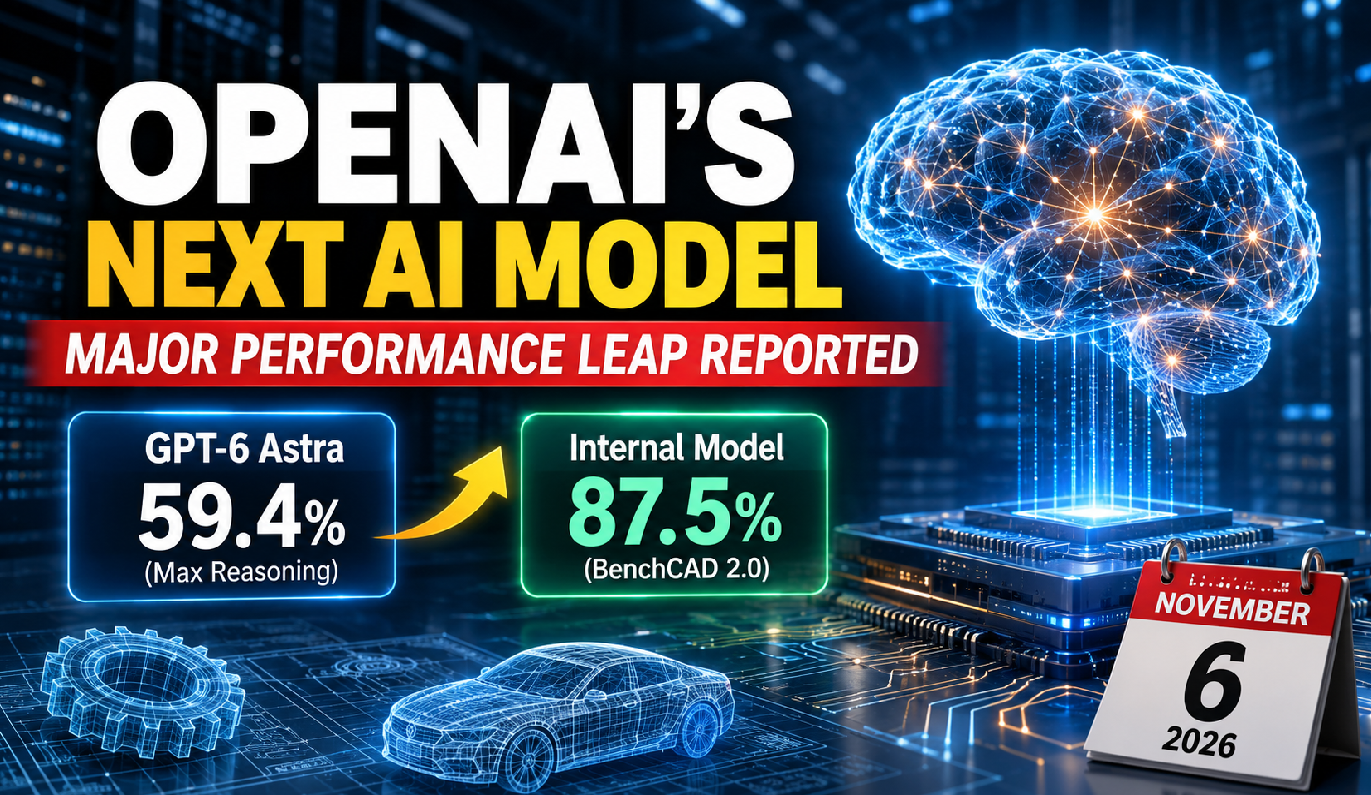
The OpenAI new AI model 2026 story is gaining attention after reports suggested that the company could introduce another generation of highly capable AI systems as early as Friday, November 6.
The OpenAI new AI model 2026 could represent a major development in advanced artificial intelligence, particularly in engineering, reasoning and complex problem-solving.
The reported lineup could include updated versions of OpenAI’s Astra and Sol models, along with a cybersecurity-focused system. More interestingly, an unreleased OpenAI model that has reportedly demonstrated a major advantage over GPT-6 Astra in engineering tasks could also become available.
However, there is an important caveat: OpenAI has not officially confirmed that the internal model will be released on November 6. The release information is based on reporting and claims circulating online, while OpenAI’s own published benchmark data confirms that the internal system has achieved impressive engineering results.
Why the OpenAI New AI Model 2026 Is Creating Buzz
The biggest reason behind the excitement is not simply the possibility of another AI launch.
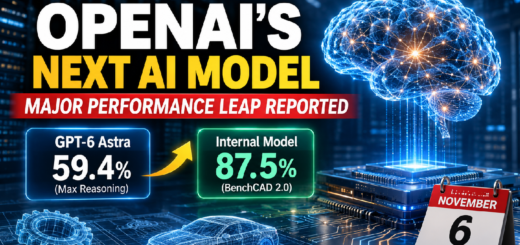
OpenAI recently published results showing that an unreleased internal model achieved an average 87.5% score on BenchCAD 2.0.
For comparison, GPT-6 Astra scored 59.4% when operating at its maximum reasoning setting.
That represents a substantial difference in a benchmark designed around engineering-related tasks, including 3D models, assemblies and circuit boards.
The results suggest that OpenAI’s internal research systems may already be moving considerably beyond the performance of its publicly available models in certain specialized areas.
For readers following the development of AI assistants, this could be more significant than a routine model refresh.
You can also read our detailed comparison of ChatGPT, Gemini and Claude in 2026 to see how today’s leading AI assistants compare in practical use cases.
OpenAI New AI Model 2026: BenchCAD Performance Results
BenchCAD 2.0 is particularly relevant because it focuses on engineering problems rather than ordinary text-generation tasks.
According to the reported figures, GPT-6 Astra’s performance changes significantly depending on its reasoning level.
| Model / Setting | Estimated Cost Per Task | BenchCAD 2.0 Score |
|---|---|---|
| Astra — Low | $0.44 | 14% |
| Astra — Medium | $2.73 | 31% |
| Astra — High | $5.11 | 41% |
| Astra — XHigh | $6.67 | 45% |
| Astra — Max | $11.05 | 59% |
| Internal Model — Low* | ~$11 | ~76% |
| Internal Model — Medium* | ~$23 | ~83% |
| Internal Model — High* | ~$34 | ~86% |
| Internal Model — XHigh* | ~$37 | ~88% |
*The internal-model costs and reasoning-level labels are estimates rather than official OpenAI API prices.
The comparison originated from an analysis shared on X, with the estimated costs extrapolated from OpenAI’s published benchmark graph. Therefore, these figures should not be interpreted as confirmed commercial pricing.
Even with that limitation, the performance numbers illustrate why the reported model has attracted so much attention.
At the estimated lowest reasoning setting, the internal system was around 76%, already considerably higher than Astra’s 59% maximum result.

OpenAI New AI Model 2026: Expected Release Date
This is where the story becomes less certain.
A report from The Information said OpenAI could introduce new Astra, Sol and cybersecurity-oriented models as early as November 6, 2026. However, that report does not establish that the specific internal model tested on BenchCAD 2.0 is definitely part of the upcoming release.
A separate claim circulating on X goes further and suggests that the highly capable internal system could also be released.
So far, however, OpenAI has not officially announced the model’s name, launch date, public availability or pricing.
That means the November 6 date should currently be treated as a reported possibility rather than a confirmed launch.
For the latest official announcements, readers can follow the OpenAI Newsroom.
A New Sol Model May Also Be on the Way
The reported developments do not stop with the internal engineering model.
Another claim suggests that OpenAI is preparing an updated Sol model that could benefit from some of the training approaches used to develop its more capable internal system.
The reported approach involves intensive training through games and simulated environments, with the goal of improving reasoning and problem-solving abilities.
Importantly, the claim says the upcoming Sol model would not simply be a smaller or distilled copy of the internal system.
Instead, it could receive its own training using similar techniques.
OpenAI has not yet publicly confirmed these specific training details or released benchmark results proving how much better the next Sol model would perform compared with GPT-6.1 Sol.
Why Engineering AI Could Become a Major Battleground
AI development is increasingly moving beyond chatbots that simply answer questions.
Engineering, software development, scientific research and complex problem-solving are becoming important testing grounds for frontier AI models.
A model that can work effectively with 3D designs, assemblies and circuit boards could potentially become useful in areas such as product development, engineering analysis and technical research.
This is also consistent with OpenAI’s broader focus on using increasingly capable AI systems to accelerate research. The company has previously described progress toward AI systems that can perform increasingly complex research tasks under human supervision.
For businesses and professionals, the long-term impact may therefore be much larger than simply getting better answers from an AI chatbot.
The Cost of More Powerful AI Could Be a Problem
There is another side to the impressive benchmark results: cost.
The estimated cost of running the internal model ranges from approximately $11 to $37 per benchmark task, depending on the reasoning setting.
That is dramatically higher than the estimated cost associated with Astra’s lower reasoning modes.
However, these figures are not official API prices. They are estimates based on the benchmark analysis and should not be confused with a commercial pricing announcement.
This highlights a broader challenge for the AI industry.
As models become more capable, developers may need to spend substantially more computing resources to solve difficult problems. The real commercial question will therefore be whether the additional intelligence produces enough value to justify the higher operating cost.
For businesses already experimenting with AI automation, this could influence which models they choose for everyday tasks versus complex professional workloads.
You can also explore our article on whether AI can replace social media managers in 2026 for a look at how increasingly capable AI systems are affecting digital marketing jobs.
What Could Happen on November 6?
If the reports are accurate, November 6 could become an important day for OpenAI.
Potential announcements could involve:
- A new Astra model
- An updated Sol model
- A cybersecurity-focused AI system
- Wider access to more advanced reasoning capabilities
- Possible improvements in engineering and problem-solving
- New information about AI model pricing and availability
But it is important not to treat every reported detail as confirmed.
OpenAI has not officially announced that the internal BenchCAD model will launch, and there are currently no confirmed public details about its final name, pricing or access.
What the Latest Benchmarks Really Tell Us
Regardless of whether the reported Friday launch happens, the BenchCAD results provide an interesting look at the direction of frontier AI.
An internal OpenAI system reportedly reached 87.5%, compared with 59.4% for GPT-6 Astra at maximum reasoning.
That does not mean the internal model is automatically better at every possible task. Benchmarks measure specific capabilities, and performance on engineering problems cannot by itself establish overall superiority across writing, coding, research, mathematics, computer use or other areas.
Still, the gap is large enough to show that OpenAI is continuing to experiment with systems that can push beyond the capabilities of its current flagship models.
Final Thoughts
The OpenAI new AI model 2026 reports point toward another potentially significant step in the rapidly changing AI industry.
The most compelling evidence is currently the company’s reported BenchCAD 2.0 results, where an unreleased internal model achieved 87.5% compared with GPT-6 Astra’s 59.4%.
At the same time, the rumored November 6 release should be viewed carefully because OpenAI has not officially confirmed that this particular internal model will become publicly available.
If OpenAI does release a system with performance close to the reported internal results, it could raise expectations for what AI models can accomplish in engineering, reasoning and complex professional workflows.
Interest in the OpenAI new AI model 2026 is growing as users wait to learn more about its official release, capabilities and potential pricing.
For now, the most important development to watch is not simply whether a new model launches, but how much of the internal performance OpenAI is willing and able to bring to users at a commercially practical cost.